Montana has taken steps toward greater transparency and recognition of wildfire mitigation. Here is what the changes may mean at renewal.
Wildfire risk is no longer a seasonal conversation for many Western Montana homeowners. It can affect whether a carrier will quote a property, what conditions must be corrected, what premium is charged and whether a policy is renewed. Montana’s 2025 legislative session produced two important changes intended to give homeowners more information and reward risk reduction.
Change No. 1: More transparency around wildfire risk scores
House Bill 533 addresses insurers’ use of wildfire-risk models. According to the Montana Commissioner of Securities and Insurance, a homeowner may request information about the data and methodology behind a wildfire risk score used by an insurer. The practical value is straightforward: if a score affects your eligibility or price, you have a better opportunity to understand the decision and identify outdated or inaccurate property information.
A risk score is not the same thing as a guarantee that a fire will occur. It is an underwriting tool. Models can consider factors on the property and beyond the property line, including topography, vegetation, road access, nearby fuel and fire-response capability. This is why mitigation at one home is valuable but may not eliminate every underwriting concern.
Change No. 2: Insurers may recognize mitigation with premium reductions
House Bill 136 allows insurers to offer premium reductions for qualifying wildfire mitigation or resilient construction. Examples cited by the state include ignition-resistant roofing, fire-resistant siding and noncombustible landscaping. The law permits these credits; it does not mean every insurer must offer the same discount or accept the same evidence.
Homeowners should ask their agent what the carrier recognizes before beginning a project solely for an insurance discount. Many improvements are worthwhile for life safety and property protection even when a premium credit is unavailable, but expectations should be clear.
A practical wildfire-insurance checklist
- Ask whether a wildfire score or aerial imagery affected the quote, renewal or inspection requirement.
- Request the available risk-score information when a decision appears inconsistent with the current condition of the property.
- Keep roofs and gutters free of needles and leaves; remove combustible material next to the home.
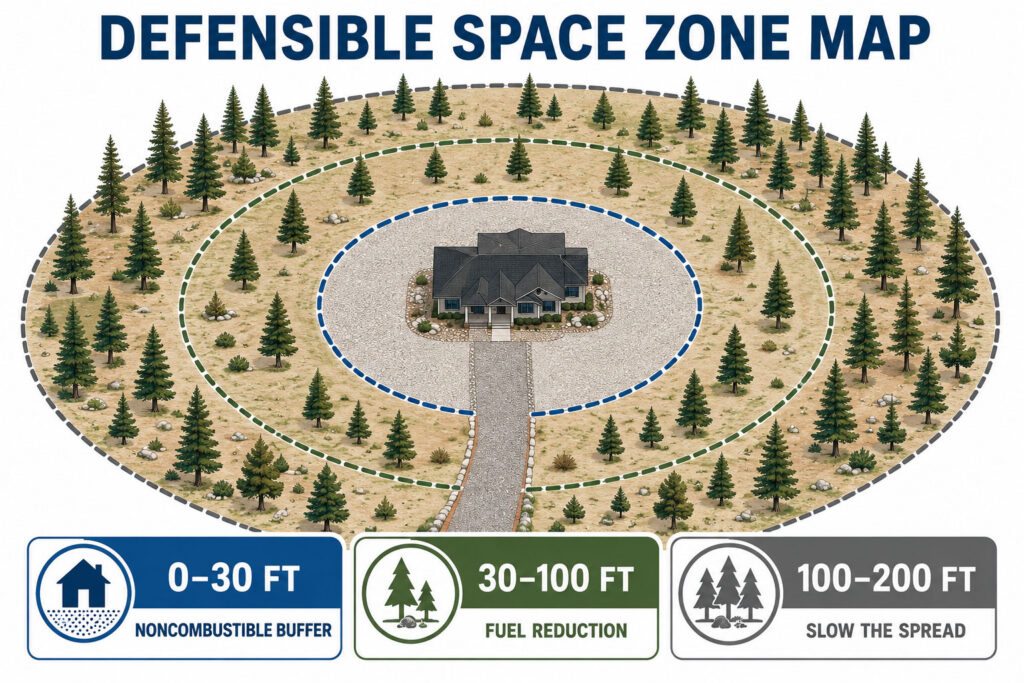
- Maintain defensible space while following local guidance for vegetation type, spacing and terrain.
- Clearly mark the address and keep driveways accessible for emergency vehicles.
- Use ignition-resistant materials when replacing a roof, siding, vents, decks or fencing near the structure.
- Photograph completed work and keep contractor invoices, inspection reports and program certifications.
- Revisit dwelling and debris-removal limits; a wildfire can create site-access, demolition and disposal costs beyond ordinary construction.
Important: Do not wait until a nonrenewal to begin mitigation. Underwriting rules, inspection timelines and carrier appetites vary, and work completed well before renewal is easier to document and present.
What to do after a wildfire-related nonrenewal
Read the notice carefully and note the effective date. Ask whether the decision can be reconsidered after specific corrections. Gather photographs, inspection records and proof of completed work. Then begin reviewing alternatives immediately; standard-market, specialty and surplus-lines policies can differ significantly in coverage, deductibles and consumer protections.
An independent agent can help organize this process, identify which insurers may fit the property and explain the differences among options. No agent can guarantee eligibility, but a well-documented submission gives underwriters better information than an address alone.
Sources and further reading
• Bitterroot Valley Community Wildfire Protection Plan (2025)